

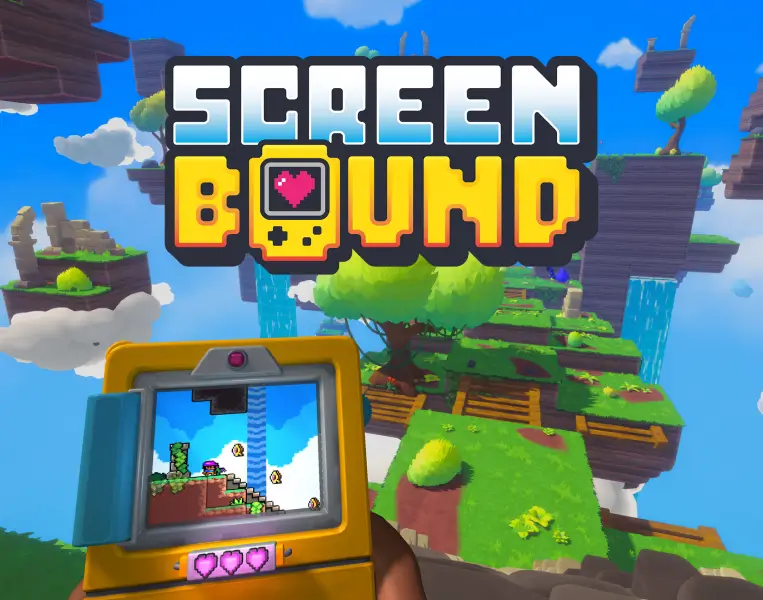
What happens when your handheld game becomes part of the world around you? Screenbound turns a retro 2D game and a 3D adventure into one interconnected puzzle.
Sometimes an indie game only needs one strange idea to stand out.
Screenbound has one: you aren't playing a 2D game inside a 3D game.
You're playing both at the same time.
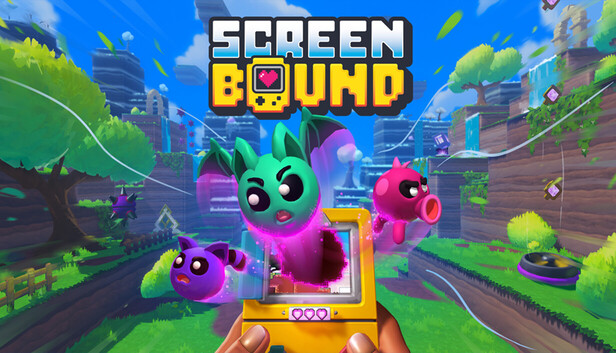
Developed by Crescent Moon Games and Radical Forge, Screenbound is an action-adventure platformer built around a mysterious handheld console called the Qboy.
And turning it on changes reality.
Two Worlds. One Player.
The story begins when you discover the Qboy in your mother's garage.
The strange handheld console appears to contain a retro-style 2D game. But when you power it on, the 2D world and the surrounding 3D world begin existing simultaneously.
That's where Screenbound's central mechanic comes into play.
Your character exists in both realities, and actions in one world can affect what happens in the other.
The rules aren't necessarily the same, however.
That means players need to constantly pay attention to both perspectives.
The Screen Is Part of the Game
Screenbound's biggest idea is that the handheld screen isn't simply displaying information.
It's part of the gameplay.
The 2D and 3D versions of the world can contain different platforms, objects and enemies. Some things may only exist in one reality.
A path that appears impossible in 3D might become accessible through something happening in the 2D world.
That turns the screen itself into another dimension to think about.
The developers describe the result as a “5D” platformer, combining the information from both worlds into its puzzle design.
Puzzles Across Two Perspectives
Screenbound isn't simply asking players to jump between 2D and 3D environments.
Its puzzles require players to understand how the two spaces interact.
Timing matters.
Perspective matters.
Logic matters.
You might need to understand what's happening on the Qboy screen before making your next move in the 3D environment.
The Steam listing describes puzzles that require shifting perspective, timing and logic across the two planes of existence.
Retro Meets 3D
Visually, Screenbound combines two distinct styles.
The Qboy provides a retro-inspired 2D world with pixel-art aesthetics, while the surrounding environment uses a stylized 3D presentation.
That contrast isn't merely cosmetic.
It reinforces the game's central idea: you're constantly looking at two different versions of reality.
One feels like an old-school platformer.
The other feels like a modern 3D adventure.
Together, they create Screenbound's identity.
More Than Just a Gimmick
The interesting question is whether the dual-world mechanic can remain compelling beyond the initial novelty.
That's where the puzzle design becomes important.
Screenbound introduces new tools and abilities as players progress, expanding the number of ways the two realities can interact.
The game also uses environmental storytelling, with players exploring unusual areas and uncovering secrets along the way.
So the two-world mechanic isn't only being used for movement.
It's also part of exploration and discovery.
Watch Both Worlds
One of the biggest challenges could be simply keeping track of everything.
Screenbound deliberately creates situations where objects, enemies and platforms may exist in only one of the two worlds.
That means players can't necessarily focus exclusively on the character in front of them.
The Qboy screen could contain information that changes how you approach the 3D environment.
It's a concept that rewards players who are comfortable thinking about multiple pieces of information simultaneously.
An Interesting Take on Platforming
Platformers have experimented with perspective, dimensions and reality before.
Screenbound's approach is different because it makes two versions of the game world simultaneously relevant.
Instead of switching from one mode to another, you're expected to understand both.
That creates a potentially interesting puzzle loop:
Observe → understand both worlds → act → see the consequences → adapt.
For players who enjoy puzzle-platformers, that alone makes Screenbound worth keeping an eye on.