
Toyota Fluorite is an open-source, "console-grade" 3D engine designed to deliver high-fidelity interactive experiences on lower-end and embedded hardware. Unlike traditional engines like Unity or Unreal, it is built specifically to be lightweight, avoiding high licensing fees and heavy resource requirements.
Core Technology Stack
- High-Performance ECS Core: Written in C++, the Entity-Component-System architecture allows for deep performance optimizations on limited hardware.
- Console-Grade Rendering: Utilizes Google’s Filament renderer and the Vulkan API to provide physically based rendering (PBR) and hardware-accelerated visuals.
- Native Flutter Integration: It is the first engine of its kind fully integrated with the Flutter SDK, allowing developers to write game logic and UI entirely in Dart.
- Cross-Platform Layer: Uses SDL3 for input and windowing, ensuring portability across mobile (iOS/Android), desktop (Windows/macOS/Linux), and embedded systems.
Distinctive Gaming Features
- Hot Reload: Developers can update game scenes, assets, and code instantly without restarting the engine, a feature inherited from Flutter.
- Model-Defined Interaction: Artists can define "touch trigger zones" directly in Blender, which are then exposed as clickable events in the code, simplifying 3D UI creation.
- Unified State Management: Game entities and UI widgets share the same state, allowing for seamless communication between the 3D world and 2D overlays using tools like Provider or Riverpod.
- Upcoming Physics: The roadmap includes integration with the Jolt Physics engine for realistic 3D interactions and movement.
Why Would a Car Company Build a Game Engine?
At first glance, it might seem strange for an automotive manufacturer to invest in game engine technology. However, the answer lies in the evolving role of software inside modern vehicles.
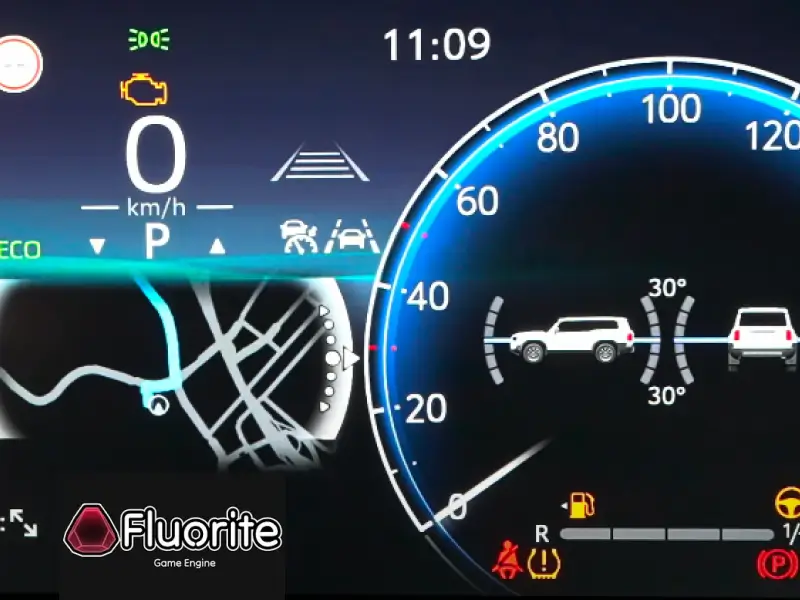
Today’s cars increasingly rely on digital dashboards, infotainment systems, and interactive displays. Automakers are experimenting with ways to make these systems more immersive, intuitive, and visually engaging. Fluorite appears to be Toyota’s attempt to build the software foundation for these next-generation in-car experiences.
Instead of traditional static menus and interfaces, Fluorite could enable 3D user interfaces, interactive vehicle tutorials, or even gaming features within a car’s digital cockpit.