


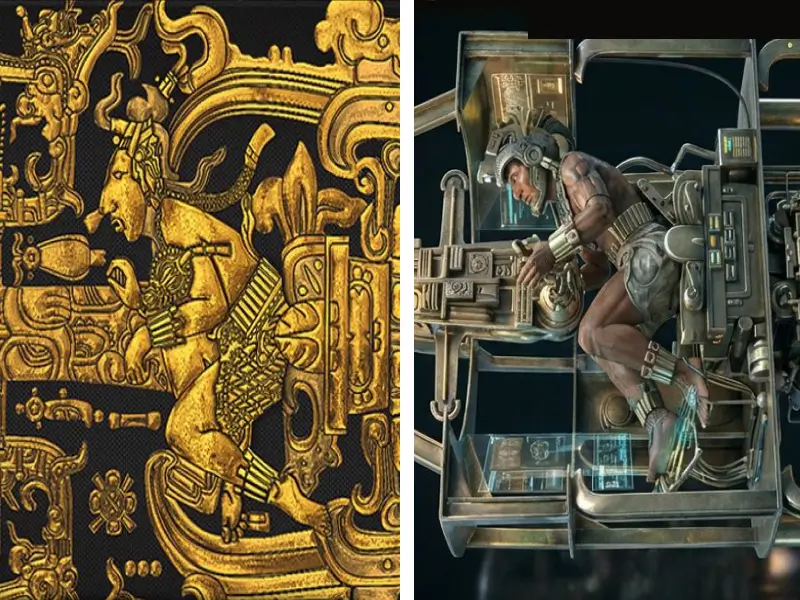
The so-called “Mayan Astronaut” is one of the most controversial and widely discussed images in ancient Mesoamerican archaeology. The carving appears on the sarcophagus lid of Kʼinich Janaabʼ Pakal, a 7th-century Maya ruler, discovered in his tomb beneath the Temple of the Inscriptions in Palenque, Mexico. The highly detailed relief has sparked debate between mainstream scholars and alternative theorists for decades.
Description of the Sarcophagus Lid
The stone relief depicts Pakal in a reclined, forward-leaning position, surrounded by complex iconography. His posture, hand placement, and the surrounding shapes have led some observers to interpret the scene as a figure operating controls within a machine. Beneath Pakal, flame-like patterns appear, while curved lines and tube-like forms encircle the central figure. These visual elements are often cited as evidence of technological imagery.
Mainstream Archaeological Interpretation
According to established Maya scholarship, the scene represents Pakal’s symbolic descent into the underworld (Xibalba) and his rebirth through cosmic transformation. The central vertical structure is identified as the Maya World Tree, a sacred symbol connecting the underworld, the earthly realm, and the heavens. Surrounding elements depict celestial bands, ancestral spirits, and mythological creatures consistent with known Maya cosmology.
Archaeologists emphasize that Maya art is highly symbolic rather than literal, and the imagery aligns with documented religious beliefs about death, kingship, and the cycle of life.
Alternative Theories and Ongoing Debate
Despite academic explanations, the carving’s unusual perspective and extreme level of detail continue to fuel alternative interpretations. Some researchers suggest the image may encode advanced knowledge, astronomical insight, or symbolic representations of technology unfamiliar to modern understanding. These theories remain speculative and are not supported by archaeological evidence but persist due to the carving’s striking visual complexity.
Why the Mayan Astronaut Still Captivates
The sarcophagus lid of Pakal remains one of the most iconic artifacts of the ancient Maya world. Whether viewed as a masterful depiction of spiritual rebirth or as a provocative image that challenges conventional narratives, the “Mayan Astronaut” continues to attract global attention and discussion.
Conclusion
The debate surrounding Pakal’s sarcophagus highlights the tension between symbolic interpretation and modern visual assumptions. As research into Maya culture continues, the carving stands as a reminder of the sophistication of ancient civilizations—and the limits of our own perspective when interpreting the past.