

Choosing a game engine isn’t just a technical decision it shapes how fast you build, how your game looks, and even whether you finish it at all.
There’s no “perfect” engine. But there is a right one depending on what you’re trying to create.
Here’s a clear, real-world breakdown of the top engines indie developers are using right now and what they’re actually good (and bad) at.

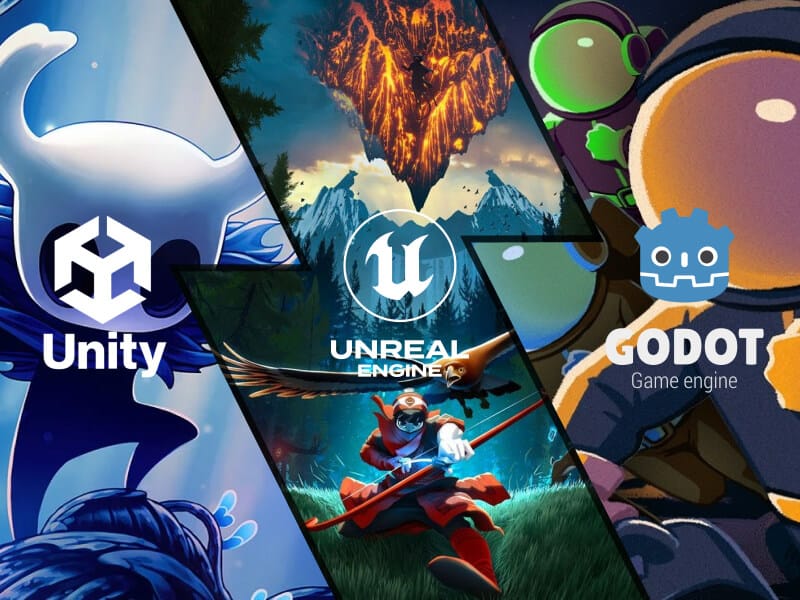
1. Unreal Engine: Still the King of Visuals
If your goal is high-end 3D with near-AAA quality, Unreal Engine is hard to beat. It’s the engine behind some of the most visually impressive games today, and its tools like Nanite and Lumen push realism further than anything else available to indie devs.
But that power comes at a cost. It’s heavy, complex, and can slow down smaller teams. For beginners, the learning curve is real.
Still, if visuals are your priority, this is the top choice.
Best for: AAA-style indie projects, realistic 3D
Score: 9.8

2. Unity: The Indie Workhorse
Unity has been the backbone of indie development for years—and for good reason. It’s flexible, supports almost every platform, and has one of the largest ecosystems of assets and tools.
It shines in mobile and cross-platform games, and it’s often the fastest way to go from idea to playable build.
That said, recent pricing controversies have made some developers cautious. Trust took a hit, even if the engine itself remains strong.
Best for: Mobile, indie, cross-platform
Score: 9.5

3. Godot: The Fast-Rising Favorite
Godot has gone from underdog to serious contender. It’s free, open-source, and improving at a rapid pace.
For 2D games, it’s already one of the best options available—lightweight, intuitive, and fast to work with. Its 3D capabilities are improving, though still not on par with Unreal or Unity.
What makes Godot stand out is freedom. No fees, no lock-in, and a growing community pushing it forward.
Best for: Indie, open-source, 2D games
Score: 9.0

4. GameMaker: Built for 2D Simplicity
GameMaker has powered countless successful indie games. It’s designed specifically for 2D, making it easy to learn and fast to use.
If you’re building platformers, pixel art games, or simple mechanics-driven experiences, it’s one of the quickest ways to get results.
The limitation is clear: it’s not built for 3D. At all.
Best for: 2D indie games
Score: 8.5

5. CryEngine: Stunning but Demanding
CryEngine delivers some of the most realistic environments in gaming. Lighting, vegetation, and large-scale worlds look incredible out of the box.
But it’s not beginner-friendly. The workflow is complex, documentation is less accessible, and development can feel slower compared to other engines.
It’s powerful—but only if you can handle it.
Best for: Realistic visuals
Score: 8.2
6. Construct 3: No-Code and Fast
Construct 3 is built for speed and simplicity. You can create games directly in your browser without writing code, making it perfect for beginners or rapid prototyping.
It’s especially popular for smaller web and mobile games.
The trade-off is scalability. Larger, more complex projects will hit limits quickly.
Best for: Beginners, no-code development
Score: 8.0

7. Defold: Lightweight and Efficient
Defold is a surprisingly strong option for mobile and lightweight games. It’s fast, free, and well-optimized.
However, its community is smaller, which means fewer tutorials and third-party resources compared to bigger engines.
Still, for focused projects, it gets the job done efficiently.
Best for: Mobile, lightweight games
Score: 7.8

8. MonoGame: Full Control, Full Responsibility
MonoGame isn’t a traditional engine—it’s more of a framework. That means you get full control over your game, but you’ll need strong programming skills to make the most of it.
It’s ideal for developers who want to build systems from the ground up rather than rely on built-in tools.
Powerful, but not beginner-friendly.
Best for: Custom development
Score: 7.5

9. RPG Maker: Niche but Effective
RPG Maker does one thing extremely well: classic JRPG-style games.
It’s simple, fast, and requires minimal technical knowledge. Many indie developers use it to tell story-driven games without worrying about complex systems.
But outside of that niche, it’s limited.
Best for: Story-driven RPGs
Score: 7.3