

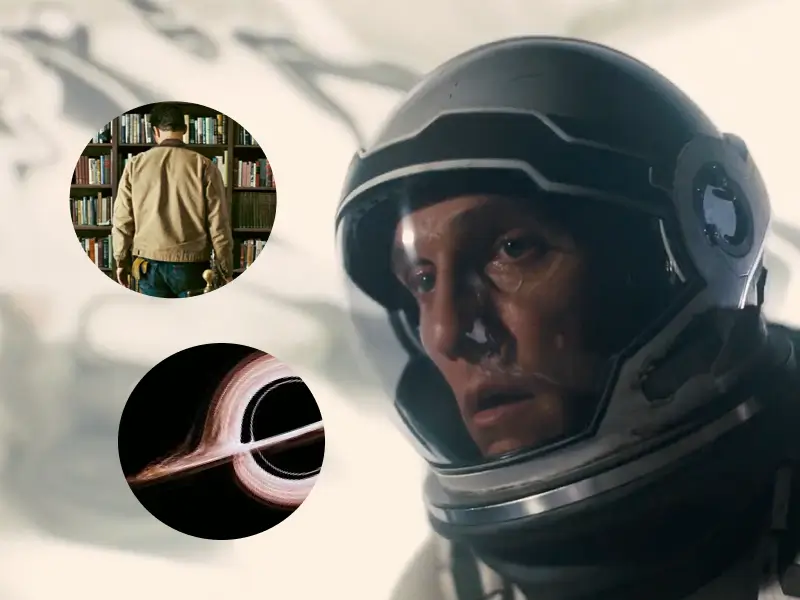
Christopher Nolan’s Interstellar isn’t just a sci-fi epic about black holes and crying in IMAX. It’s a carefully engineered emotional machine disguised as a space movie. In a brilliant video essay by Erik Voss for New Rockstars (April 7, 2023), the film is unpacked like a cosmic puzzle box—revealing how Nolan ties deeply human emotions to some of the wildest science ever put on screen.
Here’s why Interstellar hits harder every time you rewatch it
The Ghost & the Bookcase: Time Travel, But Make It Personal
One of the film’s biggest “wait… WHAT?” moments is the reveal that Cooper is the ghost in Murph’s childhood bedroom. This isn’t a last-minute twist—it’s foreshadowed early when Cooper says parents eventually become the “ghosts of their children’s future.”
The bookcase isn’t just spooky furniture. It’s a 5-dimensional communication interface, letting Cooper send gravity-based messages through time. In other words: the universe’s most emotional bookshelf.
The Blight & the NASA Conspiracy: The Quiet Apocalypse
Unlike flashy alien invasions, Interstellar shows a slow, suffocating end of the world. Earth isn’t dying from war—it’s starving. A global crop blight has reduced humanity to corn farmers and history deniers.
NASA, officially “gone,” is actually working in secret, launching desperate missions to save the species. It’s a future where science is hidden, curiosity is discouraged, and survival comes at the cost of progress. Bleak? Yes. Realistic? Uncomfortably so.
The Science of Interstellar: When Physics Is the Star
This is where Nolan flexes. With physicist Kip Thorne as a consultant, Interstellar delivered one of the most accurate black holes ever visualized: Gargantua.
Then there’s Miller’s Planet, where time dilation turns 1 hour into 7 Earth years. The result? One of the most devastating scenes in sci-fi history—no explosions, just lost time and unread messages. Science has never hurt this much.
Time Travel & the Tesseract: Humanity Saves Itself
Instead of aliens, Interstellar pulls a bold twist: the mysterious “bulk beings” are future humans. They create the tesseract so Cooper can send quantum data back to Murph, completing a causal loop where humanity becomes its own savior.
No paradox-breaking chaos. Just love, gravity, and really advanced math.
A Nod to 2001: A Space Odyssey
Sharp-eyed fans noticed the resemblance between TARS and Kubrick’s monolith from 2001. That’s not an accident. Nolan deliberately redesigned TARS to echo that iconic shape—a subtle homage linking Interstellar to the lineage of thoughtful, cerebral sci-fi.
At its core, Interstellar argues that love is a force that transcends dimensions—not in a cheesy way, but as motivation, connection, and meaning. It’s a film where equations and emotions share the same gravity.
You don’t just watch Interstellar.
You experience it… again… and again…
…and probably cry a little more each time.
Because some movies don’t age.
They just move through time differently.