

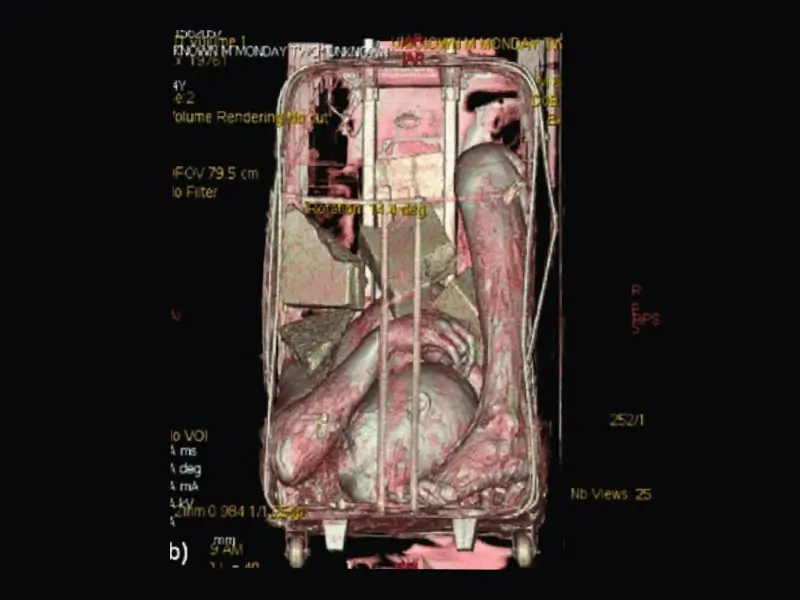
Medical CT imaging played a decisive role in a UK forensic investigation after a suitcase recovered from a canal was scanned before being opened. The scans revealed dismembered human remains, preserved the original state of the evidence, and guided investigators toward identifying the victim and locating missing body parts. The case highlights how non-invasive medical technology is reshaping modern forensic science.
At First, It Was Just Luggage
It began with an object that did not belong.
A suitcase lifted from a canal in the West Midlands felt wrong the moment it surfaced. Experienced canal workers noticed its unusual weight—dense, uneven, resistant. Rather than opening it, they stopped and contacted police.
That decision changed the course of the investigation.
A Forensic Choice That Preserved the Truth
Instead of taking the suitcase directly to an evidence room, investigators transported it to University Hospital Coventry and Warwickshire (UHCW).
Before forcing a lock or disturbing the contents, they chose a different approach:
medical-grade CT imaging.
This decision allowed investigators to examine the contents without opening the suitcase at all.
What the Scan Revealed
Layer by layer, the CT images exposed what water and time had concealed.
Inside the suitcase were tightly packed human remains. The images digitally preserved the exact state of discovery—before contamination, before evidence degradation, before human intervention.
When the suitcase was eventually opened, the scan was confirmed.
The remains belonged to an adult male.
Findings From Physical Examination
A post-scan examination revealed significant information:
- The head was missing
- Both arms were absent
- The left lower leg was missing
- Decomposition and water exposure prevented determination of cause of death
This was not a single mystery—but several overlapping ones.
Four Objectives Guided the Investigation
Investigators pursued multiple lines of inquiry at once:
- Locate the missing body parts
- Identify the victim
- Determine where the body was originally deposited
- Identify the individual responsible
The canal itself became the first lead.
A Second Discovery Upstream
Assuming additional evidence had been discarded nearby, search teams moved upstream.
They found another suitcase.
Nearby were tools:
a saw, a kitchen knife, a hammer, and a chisel—ordinary household items turned into forensic evidence.
This second suitcase was also CT scanned.
Completing the Picture With Imaging
The second scan revealed what had been missing:
- The head
- Both arms
- The remaining leg
Together, the scans showed that both suitcases contained parts of the same individual. Only one component—the left shoulder joint—remained unrecovered.
Piece by piece, forensic science reconstructed what had been deliberately scattered.
Identification Through Data, Not Recognition
Identification did not come from visual recognition.
It came from forensic data:
- DNA analysis
- Fingerprints
- Tattoos—marks chosen in life that remained identifiable in death
Samples from both suitcases confirmed they belonged to the same person.
Why CT Scanning Changed the Case
CT imaging provided key forensic advantages:
- Preserved evidence exactly as found
- Prevented contamination
- Allowed investigators to plan examinations safely
- Created a permanent digital record
- Functioned as a silent forensic witness
Medical technology became a critical investigative tool—without altering the scene.
More Than a Case About Dismemberment
This investigation was not only about violence.
It was about what remains when someone attempts to erase a person completely—and how science, even when working with fragments, insists on restoring identity and truth.