


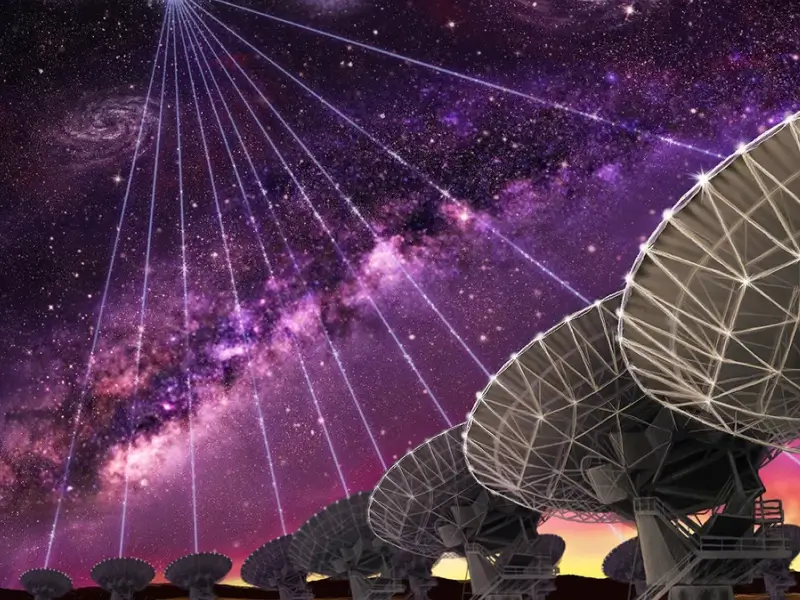
On August 15, 1977, something strange cut through the cosmic noise.
While scanning the sky, Ohio State University’s Big Ear radio telescope detected a powerful, narrowband radio signal that lasted exactly 72 seconds—the full length of the telescope’s observation window. It was so strong it measured 30 times above background noise, immediately standing out from anything previously recorded.
The signal appeared to come from the direction of the Sagittarius constellation, near the center of the Milky Way. When astronomer Dr. Jerry R. Ehman reviewed the data days later, he circled the unusual signal and scribbled a single word in the margin:
“Wow!”
That note would give the signal its name—and launch one of the greatest mysteries in modern astronomy.
The Meaning of “6EQUJ5”
The Wow! Signal wasn’t audio. It was data.
The sequence 6EQUJ5 represents how the signal’s intensity rose and fell during those 72 seconds. Each character corresponds to a strength value, showing a smooth peak and decline—exactly what astronomers expect from a distant, fixed source passing through the telescope’s field of view.
Even more intriguing: the signal was detected at 1420 MHz, the hydrogen line frequency. This frequency is considered special because hydrogen is the most abundant element in the universe, and many scientists have long believed it would be a logical choice for an artificial transmission.
Why Scientists Took It Seriously
Several factors made the Wow! Signal extraordinary:
- Narrowband: Natural sources usually produce wide, messy signals. This one was sharply focused.
- Strong: Far stronger than background cosmic noise.
- Precise duration: Exactly matching the telescope’s scanning behavior.
- Never repeated: Despite decades of follow-up observations, it was never detected again.
That combination is rare—almost unsettling.
Alien Message… or Cosmic Coincidence?
Initially, extraterrestrial intelligence was considered a real possibility. The signal checked many of the boxes scientists had predicted for an intentional broadcast.
However, science demands repeatability—and the Wow! Signal refused to cooperate.
In recent years, a new leading theory has emerged: the signal may have been caused by an interstellar hydrogen cloud that was briefly energized by an intense cosmic event, such as a magnetar flare. Magnetars are ultra-dense neutron stars capable of releasing enormous bursts of energy, potentially lighting up hydrogen at exactly the right frequency.
Earlier ideas—like space debris reflections or cometary hydrogen clouds—have largely fallen out of favor.
A Mystery That Won’t Go Away
Despite modern telescopes being far more powerful than Big Ear ever was, the Wow! Signal has never returned.
No confirmation.
No repetition.
No definitive explanation.
Nearly half a century later, that single scribbled word still captures how astronomers feel about it.